


Solar eclipses always have a certain star power, stirring up excitement across countries, regions and communities as earthlings prepare to receive the astrological phenomenon. Sometimes this excitement leads to talk of the science behind eclipses, discussions that get to the bottom of why the visual rarity happens in the first place, other times, the talk is more mystical, as humans search for spiritual meaning, lending to the moment a certain sacrality as to honor respective beliefs. Keeping the pace with the tendency to get excited about sky events, the incoming April 8 solar eclipse has a good portion of the U.S. buzzing, with Dallas in particular gearing up for what’s certain to be an exciting few hours. Especially since Dallas lucked up and landed almost dead-center of the 115-mile wide path of totality that will be experienced by portions of the U.S., Mexico and Canada. Thirteen states lie along the viewing path, and while an estimated 31 million Americans already live on the path, millions more tourists are making the trip towards the path, including the Big D.
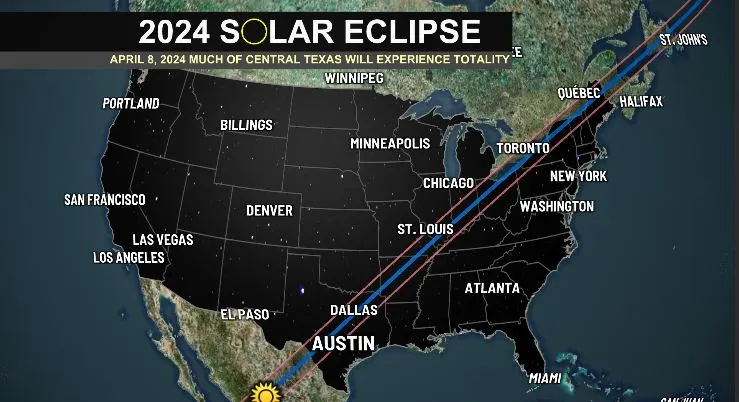
Dallas will be a prime viewing spot for the total solar eclipse, the likes of which won’t be seen again in the contiguous United States until 2044. As such, the celestial spectacle is already generating city-wide jitters for local government, first responders, employers and more, all of whom are prepared for what’s currently being estimated to be an influx of almost half a million visitors eager to witness the event. But even with the threat of increased traffic, crowded spaces and completely booked brunch reservations, the city has planned some fairly cool things as well. Some of the most interesting include doggy eclipse daycations, for those interested in hanging with a shelter pup and experiencing the eclipse with a furry friend, Addison’s “Total Eclipse of the Park”, complete with food trucks and live entertainment and Southfork Ranch’s “Eclipse & Sips”, if you’re into constellations and cocktails.
Monday’s moon crossing between our planet and our star that will plunge the day into an eerie twilight for about four minutes, for many, will mean a party. But, humans didn’t always operate that way concerning eclipses. Modern society has made the astrological event more celebratory. One could argue this is because our advances in technology and science have driven understanding of the occurrence, removing some of the mystery that our forefathers sat with. Now, rather than an eclipse being something to fear, as they were when they were still something unknown, these events are met with custom cocktails and day-parties – a testament to our advances in how we see our place in the solar system.
Still, for others, the April 8 total solar eclipse is more than just an astronomical event; it’s a chance to connect with the secrets that still elude us – the secrets that the universe still keeps. For some, this connection has been passed down through cultural traditions. Across North America, Indigenous cultures have long held a deep reverence for the natural world. Solar eclipses are seen as more than a celestial spectacle. They are a time of cultural significance, steeped in tradition and belief.

One common theme is the concept of the eclipse as a disruption of the natural order. The Navajo Nation, for instance, views the sun as a father figure. During an eclipse, they believe the sun is undergoing a temporary death only to be rebirthed and that eclipses are a chance for the universe to be reborn and realigned. Out of respect, activities cease, and a sense of quiet reverence prevails. Other tribes see the eclipse as a battle between celestial bodies. The Cherokee tell a story of a giant frog attempting to devour the sun, and how loud noises are made with drums, whistles and their voices to scare the creature away. Other traditions view it as a time of renewal. The Hopi people believe it’s a moment for prayer and ceremony, a chance to present sacred names.
In Black culture, there is a rich tradition of divinatory practices around astrological events, and recently, there has been a resurgence of Black Americans exploring both Western systems and the African ancestral practices pertaining to the stars. Throughout history, Black people’s engagement with astrology has been multifaceted, with enslaved ancestors using the sky to navigate life – from seasons, and planting cycles to underground paths to freedom. Harriott Tumban created a complex network of allies, all understanding and leveraging the skies to navigate the way for thousands seeking freedom to the north.
For enslaved people, rare phenomena in the sky were considered signs from heaven. In fact, the eclipse of 1831 is the lesser-well known trigger of one of the nations’s greatest slave revolts as Nat Turner, a deeply religious man in Southampton County, Virginia, harbored dreams of liberation for himself and other enslaved people. Fueled by religious visions and the pivotal celestial event, Turner would ignite one of the most significant slave rebellions in American history.

A key moment arrived in February 1831 when a solar eclipse plunged the land into a temporary darkness. For Turner, who’d learned to read as a child and studied the Bible fervently, this was a divine sign, a confirmation of his calling. It’s said that Nat’s exposure to the eclipse prompted him to begin recruiting trusted slaves, whispering of an impending uprising. And though the rebellion faced delays with Turner falling ill and postponing the initial plan, on August 21, 1831, a different celestial phenomenon, a hazy green sun caused by an atmospheric disturbance, spurred him back into action. Believing it to be another divine signal, Turner and his followers launched their attack on the home of Joseph Travis, Turner’s owner.
Though Nat Turner’s uprising was short lived, it would serve as a reminder for many who’d get word of the mini-revolution for miles and decades, reminding them of his bravery and willingness to fight for what all enslaved people innately knew was their birthright – freedom. Still today, for many tribes and Black Americans, an eclipse is a sign of something more and a powerful reminder of the interconnectedness of all things. It’s a time to reflect on our place in the universe and the importance of maintaining balance with the natural world. While celebrations may vary, one thing remains constant: the deep respect cultures of color hold for these celestial events.