


By Laura Onyeneho
I’m sure we’ve all heard the classic advice from our parents or relatives at one point in our lives, “Go to college, get a degree, and you’ll land a good job.” But for many graduates today, that promise doesn’t always pan out.
A recent study by Degreechoices sheds light on the uncomfortable truth—some degrees just aren’t cutting it when it comes to landing a meaningful job. If you’ve ever wondered why so many college graduates are stuck in jobs that don’t require a degree, you’re not alone.
Degrees in criminal justice, performing arts, and art history have some of the highest rates of underemployment, meaning people are working jobs that don’t even need a college degree. criminal justice, for example, tops the list with a shocking 71.5% underemployment rate. That means more than seven out of ten people who majored in criminal justice are employed in jobs where they aren’t using their degrees. It’s a tough pill to swallow, especially when you’ve spent years (and thousands of dollars) preparing for a career in that field.
Take criminal justice majors, for instance. Many go into college thinking they’ll land roles in law enforcement, social work, or even the legal system. But the reality is, after graduating, a large percentage end up working jobs with little or nothing to do with their field. Sure, the potential to earn $70,000 a year by mid-career is there, but early on, criminal justice grads are making around $41,000. With college debt and living expenses, that’s not much of a return on investment.
Then there’s performing arts and art history. I get it—these fields are full of passion and creativity. But unfortunately, passion doesn’t always pay the bills. Graduates in these areas face underemployment rates of 65.9% and 62.3%, respectively. It’s not that these degrees are worthless, but the job market is tough, and competition is fierce. Early-career wages hover around $38,000 to $41,000, which is tough to live on, especially if you have student loans.
FUN FACTS:
- Underemployment means to work in a job that typically doesn’t require a college degree.
- As of May 2024, about 40% of recent college graduates were underemployed.
- The majors with the highest levels of underemployment are criminal justice (71.5%), performing arts (65.9%), and art history (62.3%).
- Graduates who majored in nursing, engineering, and education enjoy the lowest underemployment rates overall.
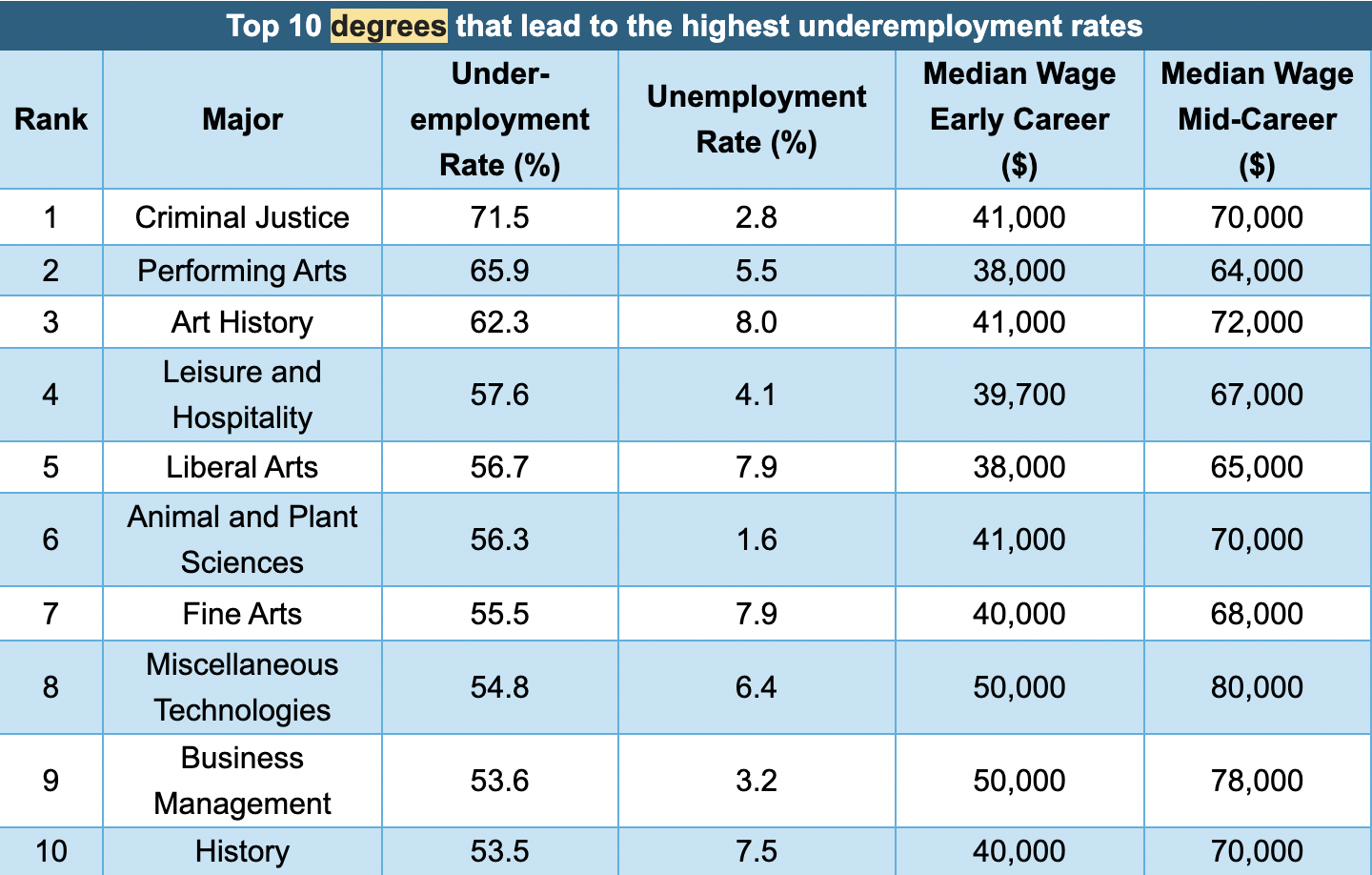
Liberal arts majors, another common path, face similar struggles. I’ll have to stand on this soap box because my degree was focused on politics, history, and communications. While the broad education teaches critical thinking, public speaking, and problem-solving, it lacks a direct career path with earning power (At that time, my focus was to study law). That can be a blessing for students who want flexibility, but it also means that many graduates end up drifting into jobs that don’t require a degree. With an underemployment rate of 56.7%, Liberal Arts graduates often earn a median of $38,000 early on. And if you choose to enter into local journalism as a focus, trust me, you’re not going to be wealthy, but your skill sets will help you get there in other ways.
Just because a certain degree might not lead directly to a high-paying job doesn’t mean all hope is lost. The key is being strategic. If you’re passionate about liberal arts, that’s great! But it’s important also to have a plan for how you’ll pivot or adapt to changes in the job market.
You may start with a degree in art history but later explore roles in business, education, or technology where your skills can still be applied. Or, if you’re an artist at heart, perhaps you look into fields like marketing, where creativity is a must. It’s about finding new ways to apply your skills and being flexible enough to explore other industries.
The job market is constantly evolving, and one of the smartest things a college graduate can do is be open to change. Just because you earned a degree in one field doesn’t mean you’re stuck in that lane forever. Many people with those degrees have found fulfilling careers in different areas.
Employers are starting to care less about your degree and more about the skills you bring. That’s why gaining additional certifications, learning new skills, or gaining real-world experience can help make you more marketable, no matter your major.
The post Which College Degrees Are Least Likely to Land You a Job? appeared first on Word In Black.
The post {{post title}}, https://wordinblack.com/2024/11/which-college-degrees-are-least-likely-to-land-you-a-job/ appeared first on Word in Black.