


Overview:
Black students experience disproportionate school discipline, with Black students representing 15% of the K-12 student population but accounting for 28% of students referred to law enforcement and 33% subjected to school-related arrests. This disparity in discipline has a direct impact on their academic growth, with achievement divides widening between Black and white students from 35 points in 2020 to 42 points in 2023. The National Education Association's data shows a 35% reduction in student arrests and an 18% decrease in out-of-school suspensions in 2023. The author advocates for policy changes such as rewriting school codes of conduct, reconsidering police presence in schools, and creating a discipline accountability review board that includes students.
It’s become routine for acts of school violence against Black children to float across our news feeds: In 2019, a Minnesota teacher segregated the Black students in her second-grade classroom and choked one of them. In 2020, Police handcuffed and dragged a 6-year-old girl in Orlando to jail. Her offense: Throwing a tantrum in class. Who can forget her pitiful cries for help in the police bodycam video: “Help me, help me, please, help me.”
Then there’s the horrifying clip of an 11-year-old sixth-grade boy in Savannah, Georgia, thrown across the room by his teacher in December — after the teacher allegedly made sexual remarks about the boy’s mom and the student confronted him. And how about a Houston-area district suspending high schooler Darryl George during the 2023-2024 school year because he wore his natural hair in locs?
Those are all just a snapshot of the disproportionate school discipline Black students experience — and after those children and their classmates are traumatized, they’re expected to set that harshness and violence aside and focus on academics: Earn those A’s and B’s, even if you don’t feel a sense of safety or belonging.
RELATED: More Than Numbers: The Harsh Discipline of Black K-12 Girls
A new pair of reports — the 2025 Civil Rights Data Collection (CRDC) and the 2024 National Assessment of Educational Progress (NAEP) — reveal exactly how school discipline blocks Black students’ ability to learn and achieve.
“The data points are no coincidence,” says Rhianna Scyster, education policy expert and founder of the Jacksonville Policy Engagement Group. “The link between increased discipline and decreased academic performance cannot be ignored because it shows us that the current practices in place are systematically removing Black students from the classrooms, which directly impacts their academic growth.”
The Discipline-Achievement Divide
The CRDC’s latest findings show that Black students face school disciplinary actions at rates significantly higher than their white peers. For instance, while Black students represent 15% of the K-12 student population, they account for 28% of students referred to law enforcement and 33% subjected to school-related arrests.
Moreover, a comparison of data from the 2020-21 and 2021-22 CRDC reports indicates troubling increased trends in the following areas:
- School-Related Arrests: Black students accounted for 31% in 2020-21, increasing to 33% in 2021-22.
- Corporal Punishment (Black Boys): In 2020-21, Black boys represented 18% of students receiving corporal punishment. This number rose to 20% in 2021-22.
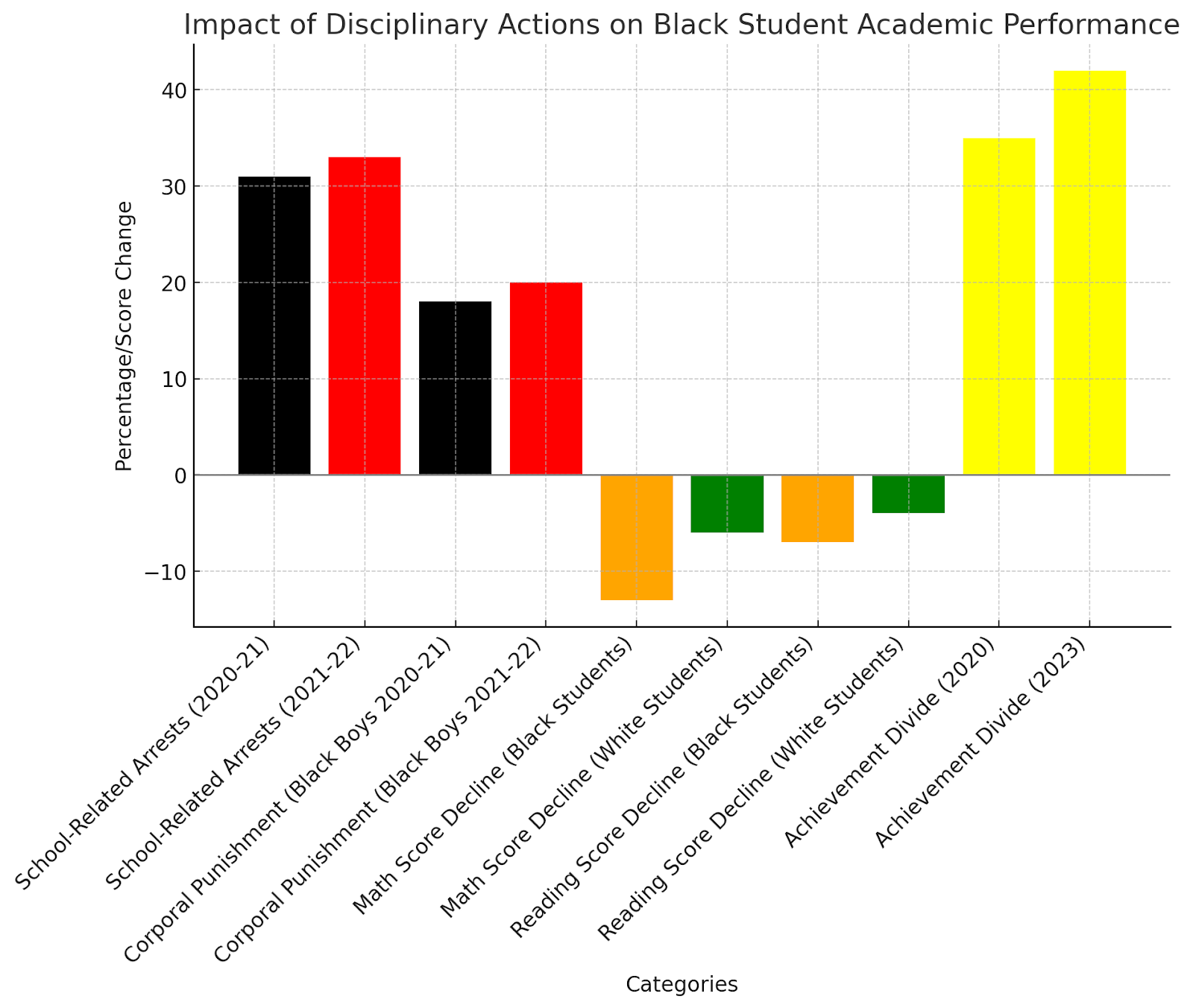
Additionally, the 2024 NAEP report indicates that achievement divides between Black and white students have not only persisted but, in some areas, widened. For example, between 2020-2023, Black students experienced a 13-point drop in math and a 7-point drop in reading scores, compared to a 6% decrease in math and a 4% decrease for white students.
The overall achievement divide widened from 35 points in 2020 to 42 points in 2023, showing that disciplinary rates increased for Black students as academic performance decreased.
RELATED: From Homeroom to Handcuffs
“When students are repeatedly removed from their learning environments, they miss out on critical instructional time and social opportunities,” Scyster notes. “This not only isolates them, but contributes to another loss of safety and belonging which further hinders their learning focus.”
Why Are Black Students Punished More?
Decades of research show that Black students are more likely to be punished for subjective offenses deemed as “defiant” or “disruptive” compared to their white peers who engage in similar actions.
“Unfortunately, teachers often interpret Black students’ behaviors more harshly due to implicit biases,” Scyster explains. “For example, Black boys are often labeled as ‘aggressive’ for normal childhood behaviors, while Black girls are frequently adultified and seen as ‘too mature’ for their age.”
In addition to bias, Scyster says systemic factors like the over-policing in Black schools and the use of zero-tolerance policies further exacerbate the problem. “Predominantly Black schools have more police officers but fewer counselors and support staff,” she adds. “That level of over-policing leads to over-discipline, which directly affects Black students learning outcomes.”
Changing the Narrative
So, how can schools shift away from discipline practices that disproportionately impact Black students? Scyster says the first thing will involve deconstructing the implicit bias that assumes that Black students misbehave more than their peers. “The current disparity is not largely due to higher rates of misbehavior but rather the differences in how their behavior is perceived and judged,” she says.
She also advocates eliminating out-of-school suspensions and school-related arrests at the elementary level as a critical first step.
“We need to plug the pipeline before it starts,” she says. “Once a student is suspended in third grade, they’re more likely to continue receiving suspensions throughout their academic career.”
Additionally, implementing restorative justice practices centered on mediation and student engagement rather than punishment has shown positive results. Scyster pointed to data from the National Education Association that found, in 2023, a 35% reduction in student arrests and an 18% decrease in out-of-school suspensions.
Get Students Involved in Reforms
Scyster says that educators and policymakers must act with urgency at the district and state levels to address this growing crisis and offers the following policy recommendations:
- Rewriting school codes of conduct to remove subjective language such as “disrespect” and “disruption.”
- Reconsidering police presence in schools, especially in over-policed Black communities.
- Creating a discipline accountability review board that includes students.
- Requiring restorative justice consultants in schools with high discipline disparities.
Moreover, Scyster asserts that students must be at the table when addressing equitable ways to improve their outcomes.
“If we are making decisions about students, they need to be in the room, too,” she says. “We cannot have these conversations without the very people who are being affected by them.”
The post Black Students Are Punished More, Then Expected to Succeed appeared first on Word In Black.
The post {{post title}}, https://wordinblack.com/2025/02/black-students-are-punished-more-then-expected-to-succeed/ appeared first on Word in Black.