Overview:
Ida B. Wells was a journalist and activist who exposed the truth about lynchings in the Jim Crow South. She wrote the pamphlet "Southern Horrors: Lynch Law in All Its Phases" and published "A Red Record" which revealed that most lynchings had nothing to do with white women. Wells was a co-founder of the NAACP and the National Association of Colored Women, and she continued to fight for change until her death. In 2025, the current presidential administration is attacking the press, and it's more important than ever to remember the importance of truth-telling in journalism.
“The way to right wrongs is to turn the light of truth upon them.”
Ida B. wells
An icon. A muckraker. A “Negro Adventuress.” Those are just a few of the labels conferred on this remarkable woman who exposed the truth about lynchings in the Jim Crow South.
The future cofounder of the NAACP and the National Association of Colored Women, Ida Bell Wells, was born into slavery on July 16, 1862. She attended Rust College (formerly Shaw University), LeMoyne-Owen College, and Fisk University.
In 1878, both of her parents and her infant brother passed away due to yellow fever. At just sixteen, she became the caretaker for her six remaining siblings. After passing her teaching exam in 1880 at Rust, she became a school teacher and moved to Memphis, Tennessee.
Wells’ journalistic career began in Memphis, she became the editor of The Evening Star, the local newspaper. She also wrote for The Living Way under the alias “Iola.” Her work at The Star addressed the racial issues that plagued African Americans daily. She ventured and joined Free Speech (later, the Memphis Free Speech and Headlight) as both partner and editor.
As an activist, Wells made history in 1883 when the then-20-year-old sued the Chesapeake, Ohio and Southwestern Railroad Company after being forcibly removed from the train for refusing to move when asked by a white conductor. Just reading some of the testimony gives you an inkling of the fiery advocate she would soon become.
“I replied that I would not ride in the forward car, that I had a seat and intended to keep it,” Wells testified. “He said to me that he would treat me like a lady, but that I must go into the other car, and, I replied that if he wished to treat me like a lady, he would leave me alone.”
Incredibly, Wells won and was awarded $500 in damages, the equivalent of $20,000 in 2025. However, the railroad appealed, and upon reaching the Tennessee Supreme Court, the decision was reversed.
Wells made her mark in the journalistic world as a muckraker, a pejorative term used to describe investigative journalists during the Progressive Era who exposed corruption and social problems.
The “Princess of the Press” was already a thorn in the side of white Memphians before gaining fame after she reported the truth about her friends’ lynchings. See, Ida had a way with words. Her ability to weave them together like a lyricist, coupled with her quick wit, had already made her a very public target.
So when the owners of the People’s Grocery Store, Thomas Moss, Calvin McDowell, and Henry Steward, were brutally murdered, she spilled all the tea. Wells was writing not only about the inconsistencies of the case, but also highlighting the racial prejudice that plagued the entire community. Thus, she highlighted the fact that the profitable and popular store threatened the position of a local white grocery store.
However, that turned out to be the last straw for the white Memphians she had spent a decade mocking to their faces. As a result, Wells was forced to leave her home in Memphis after her Free Speech office was set ablaze.
Yet, Wells would remain steadfast in exposing lynchings. She published her pamphlet, Southern Horrors: Lynch Law in All Its Phases, in 1892. The pamphlet explained how lynch mobs were formed and how white officials would justify the acts. Shortly after the publication, she was hired by The Chicago-Intern to investigate American South lynchings.
In 1895, she married Ferdinand Lee Barnett, with whom she would have four children, and also published A Red Record, a book that offered statistical data on lynchings in America. This data revealed a stunning truth and crushed the prevailing narrative: that these extralegal murders were emotional responses by white men “avenging” wives and daughters. In fact, A Red Record showed that most lynchings had nothing to do with white women.
An activist through it all, her work never stopped when she was away from pen and paper. She was an active participant in the Women’s Suffrage movement and the social justice of Black Americans. But make no mistake, that pen and paper continued to garner the world’s attention.
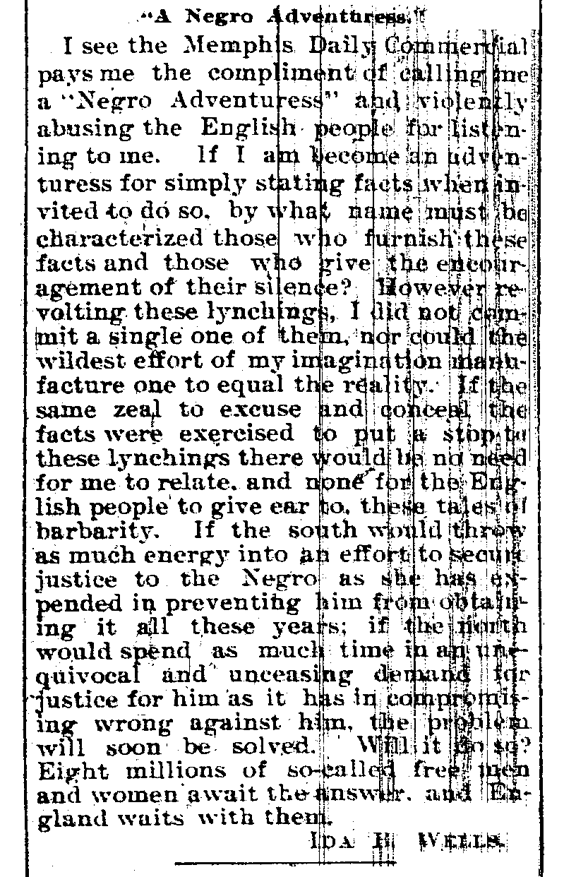
Take this response that she wrote to the Memphis Commercial Daily upon their criticism of her speaking to English audiences about lynching for example:
I see the Memphis Daily Commercial pays me the compliment of calling me a “Negro Adventuress” and violently abusing the English people for listening to me. If I am become an adventuress for simply stating facts when invited to do so, by what name must be characterized those who furnish these facts and those who give the encouragement of their silence? However revolting these lynchings, I did not commit a single one of them, nor could the wildest effort of my imagination manufacture one to equal the reality. If the same zeal to excuse and conceal the facts were exercised to put a stop to these lynchings there would be no need for me to relate, and none for the English people to give ear to, these tales of barbarity. If the south would throw as much energy into an effort to secure justice to the Negro as she has expended in preventing him from obtaining it all these years; if the north would spend as much time in an unequivocal and unceasing demand for justice for him as it has in compromising wrong against him, the problem will soon be solved. Will it be so? Eight millions of so-called free men and women await the answer, and England waits with them.

From 1898 to 1902, Wells served as the secretary for the National Afro-American Council. In 1910, she founded and served as the first president of the Negro Fellowship League, which helped new migrants from the South. She also founded the Alpha Suffrage Club, which became one of the most important women’s suffrage clubs in Chicago. She continued on with a life of fighting for change when she ran for an Illinois State Senate seat in 1930, becoming the first Black woman to run.
Ida B. Wells broke barriers at a time when yellow journalism was on the rise. She maintained her fight for truth-telling journalism when hundreds were trying to silence her voice. Wells was determined to be heard. She never gave up.
More than a century later in 2025, the U.S. presidential administration is attacking the American press. Trump and his team are actively working against the media outlets that do not fulfill their demands for a hyper-positive image.
From banning the AP Newsroom for refusing to refer to the Gulf of Mexico as the Gulf of America, to redoing the entire press pool to fill it with people who are known MAGA supporters, this administration is trying to turn the press into public relations.
Related: Importance of Truth Telling in Journalism in a Political Atmosphere of Censorship
However, that is not what an unbiased press is supposed to be. The press serves the American people. At Dallas Weekly, we serve not the government and its interests, but the people. The people deserve all available information in order to construct their own idea of objective truth, not a fluffed version of “fake news” packed with half-reported statistics to make people feel content with a lapse of critical thinking. The press is used to hold accountable the powers in be, whether it be positive or negative.
So, in a time where journalism is being attacked, let us strive to be muckrakers in remembering the great words of Ms. Ida B. Wells.
“I’d rather go down in history as one lone Negro who dared to tell the government that it had done a dastardly thing than to save my skin by taking back what I have said.”
Ida B. Wells

Additional reporting by Sherri Yarbrough